
What Is a DoS Attack? Types, Signs, and Prevention

Imagine your website suddenly stops working. Your employees cannot access important systems. Customers cannot reach your website. Your network becomes very slow.
At first, you may think it is a normal IT problem. But sometimes, the problem is a DoS attack.
For businesses, even a brief downtime can result in lost work, displeased customers, and additional IT expenses.
In this blog, we will discuss what a DoS attack is and why it happens, the different types, warning indicators for threats, the difference between a DoS and DDoS, and how businesses can protect themselves.
What Is a DoS Attack?
Denial-of-Service attack is an attempt to prevent a system or service from functioning properly.
A large quantity of traffic, requests, or other data is sent to a target by an attacker. The target is constrained by resources, e.g., processing power, memory, bandwidth, etc. or connectivity.
If these resources get overloaded, the system can become very slow or hang. For instance, a tiny shop that has only one person working there.
Typically, the employee will be able to assist customers on an individual basis. However, if hundreds of people come into the store and all of them need assistance, the employee will not be able to assist all.
How Does a Denial-of-Service Attack Work?
This type of attack can happen in different ways, but the main goal is usually the same: use up the target's available resources.
A simple attack may send a large number of requests to a server. Eventually, it may not have enough capacity to handle normal users.
This can lead to:
- Slow websites
- Slow network performance
- Failed connections
- Application problems
- Server crashes
- Users being unable to access a service
Some attacks also take advantage of weaknesses in software or systems. These attacks can cause a system to use too much memory, CPU, disk space, or other resources.
The exact method can be different, but the result is similar: legitimate users cannot use the service normally.
What Are the Common Types of Denial-of-Service Attacks?
Denial of Service attacks can take different forms. Two broad categories discussed by Cloudflare are flood attacks and buffer overflow attacks.
1. Flood Attacks
A flood attack sends a large amount of traffic or requests to a target.
The goal is to use up the target's available network or system capacity.
If the target cannot handle the traffic, normal users may experience slow connections or may not be able to connect at all.
2. Ping Floods
A ping flood sends a large number of ICMP ping requests toward a target. When the requests come from multiple devices, it becomes a DDoS attack.
A system may become overwhelmed when it receives more requests than it can efficiently process.
3. Buffer Overflow Attacks
A buffer overflow attack takes advantage of a software weakness that can cause a system to use too much memory or other resources.
This can result in slow performance, system crashes, or other service problems.
DoS vs. DDoS: What Is the Difference?
Denial-of-Service and Distributed Denial-of-Service attacks have the same basic goal: make a service, device, or network unavailable to normal users.
The main difference is where the attack traffic comes from.
A Denial-of-Service attack usually comes from one source.
A Distributed Denial-of-Service attack comes from many sources.
| DoS Attack | DDoS Attack |
| Usually comes from one source | Comes from multiple sources |
| Often uses one attacking system | Can use many compromised devices |
| Has a more centralized traffic source | Traffic comes from a distributed network |
| Can make a service unavailable | Can also make a service unavailable |
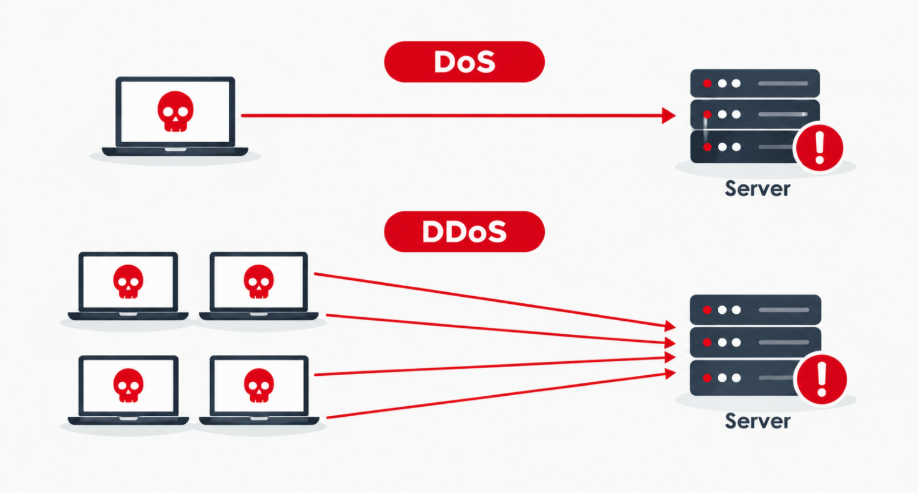
The terms are related, but they are not exactly the same.
How Can a DoS Affect a Business?
These attacks are mainly focused on availability, but the business impact can go beyond a temporary outage.
Lost productivity
If employees cannot access important applications or systems, work can stop.
Lost sales
If customers cannot access your website or online services, you may lose sales and leads.
Downtime
Even a short period of downtime can interrupt normal business operations.
Customer frustration
Customers expect websites and online services to work. Repeated outages can make the customer experience worse.
IT costs
Your IT team may need to spend time finding the cause, stopping the attack, restoring services, and checking systems.
Reputation problems
If an important service keeps going offline, customers may lose confidence in the business.
This is why Denial-of-Service protection should not only be viewed as a technical issue. It is also a business continuity issue.
How Can Businesses Prevent DoS Attacks?
No single step is able to prevent all attacks. Businesses should use several layers of protection.
1. Monitor Network Traffic
Your IT team can use regular monitoring to learn the characteristics of the normal traffic.
If you see unusual traffic, it might be easier to spot a potential issue.
2. Use Network Security Tools
Security measures such as firewalls can be used to limit the access of unwanted traffic and to also preserve the safety of the network resources.
3. Keep Systems Updated
Old software and systems may be vulnerable to security flaws. Regularly patching systems helps fix known security vulnerabilities and reduces opportunities for attackers.
4. Monitor Servers and Devices
IT monitoring can help your team identify any unusual CPU, memory, bandwidth and system activity.
Early warnings can aid your team to investigate a problem before it turns into a bigger outage.
5. Work With an IT Security Provider
A large security staff may not be available for small and medium-sized businesses all day, every day. An MSP can assist in incident response planning, security tools, network management, patching, and monitoring.
Final Thoughts
A DoS can turn a normal business day into a serious IT problem. The good news is that businesses do not have to wait until an attack happens to prepare.
Regular monitoring, security updates, network protection, and a clear response plan can help your business identify problems faster and reduce downtime.
Need help managing and protecting your business IT?
MSP Depot provides IT monitoring, remote support, patch management, automation, security support, and other IT services to help businesses keep their systems running.
Start your free 60-day trial today. No credit card required.
Start Your Free 60-Day Trial
Contact MSP Depot
FAQs
What is a DoS attack in simple words?
A DoS attack is a cyber attack designed to make a website, server, computer or network unavailable by overloading it with traffic, requests or any other activity.
What is the difference between DoS and DDoS?
A Denial-of-Service attack is typically single source, whereas a Distributed Denial-of-Service attack is many sources.
Can a DoS shut down a website?
Yes. A successful Denial-of-Service attack can cause a website to become slow or unavailable by consuming the resources required by normal users of the website.
How do I know if my business is under a Distributed Denial-of-Service attack?
Try to identify any sudden and abnormal slowdowns, site downtime, connectivity issues, and abnormal network activity. But these symptoms may also be caused by other means and a thorough IT investigation is required to determine if an attack occurred.
Can small businesses be targeted by Distributed Denial-of-Service attacks?
Yes. Availability issues can impact any business that relies on Internet-connected systems or services. Protection level is dependent upon the business, the systems, and risk.